Chocolate 101
From Wikipedia, the free encyclopedia
Chocolate comprises a number of raw and processed foods produced from the seed of the tropical cacao tree. Cacao has been cultivated for at least three millennia in Mexico, Central and South America, with its earliest documented use around 1100 BC. The majority of the Mesoamerican peoples made chocolate beverages, including the Aztecs and the Maya, who made it into a beverage known as xocolātl, a Nahuatl word meaning "bitter water". The seeds of the cacao tree have an intense bitter taste, and must be fermented to develop the flavor.
After fermentation, the beans are dried, cleaned, and roasted, and the shell is removed to produce cacao nibs. The nibs are then ground and liquified, resulting in pure chocolate in fluid form: chocolate liquor. The liquor can be further processed into two components: cocoa solids and cocoa butter. Pure, unsweetened chocolate contains primarily cocoa solids and cocoa butter in varying proportions. Much of the chocolate consumed today is in the form of sweet chocolate, combining chocolate with sugar. Milk chocolate is sweet chocolate that additionally contains milk powder or condensed milk. "White chocolate" contains cocoa butter, sugar, and milk but no cocoa solids (and thus does not qualify to be considered true chocolate).
Chocolate contains alkaloids such as theobromine and phenethylamine, which have physiological effects on the body. It has been linked to serotonin levels in the brain. Scientists claim that chocolate, eaten in moderation, can lower blood pressure.[1] Dark chocolate has recently been promoted for its health benefits, including a substantial amount of antioxidants that reduce the formation of free radicals, though the presence of theobromine renders it toxic to some animals,[2] such as dogs and cats.
Chocolate has become one of the most popular flavors in the world. Gifts of chocolate molded into different shapes have become traditional on certain holidays: chocolate bunnies and eggs are popular on Easter, chocolate coins on Hanukkah, Santa Claus and other holiday symbols on Christmas, and hearts on Valentine's Day. Chocolate is also used in cold and hot beverages, to produce chocolate milk and hot chocolate.
History
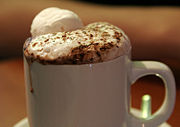
A mug of hot chocolate. Chocolate was first drunk rather than eaten.
Cacao, native to Mexico, Central and South America, has been cultivated for at least three millennia in that region. It was used originally in Mesoamerica both as a beverage, and as an ingredient in foods.
Chocolate has been used as a drink for nearly all of its history. The earliest record of using chocolate dates back before the Olmec. In November 2007, archaeologists reported finding evidence of the oldest known cultivation and use of cacao at a site in Puerto Escondido, Honduras, dating from about 1100 to 1400 BC.[7] The residues found and the kind of vessel they were found in indicate that the initial use of cacao was not simply as a beverage, but the white pulp around the cacao beans was likely used as a source of fermentable sugars for an alcoholic drink.[7] The Maya civilization grew cacao trees in their backyard,[8] and used the cacao seeds it produced to make a frothy, bitter drink.[9] Documents in Maya hieroglyphs stated that chocolate was used for ceremonial purposes, in addition to everyday life.[10] The chocolate residue found in an early ancient Maya pot in Río Azul, Guatemala, suggests that Maya were drinking chocolate around 400 AD. In the New World, chocolate was consumed in a bitter, spicy drink called xocoatl, and was often flavored with vanilla, chili pepper, and achiote (known today as annatto).[11] Xocoatl was believed to fight fatigue, a belief that is probably attributable to the theobromine content. Chocolate was also an important luxury good throughout pre-Columbian Mesoamerica, and cacao beans were often used as currency.[12] For example, the Aztecs used a system in which one turkey cost one hundred cacao beans and one fresh avocado was worth three beans.[13] South American and European cultures have used cocoa to treat diarrhea for hundreds of years.[14] All of the areas that were conquered by the Aztecs that grew cacao beans were ordered to pay them as a tax, or as the Aztecs called it, a "tribute".[15]
Until the 16th century, no European had ever heard of the popular drink from the Central and South American peoples.[16] It was not until the Spanish conquest of the Aztecs that chocolate could be imported to Europe, where it quickly became a court favorite.[16] To keep up with the high demand for this new drink, Spanish armies began enslaving Mesoamericans to produce cacao.[17] Even with cacao harvesting becoming a regular business, only royalty and the well-connected could afford to drink this expensive import.[18] Before long, the Spanish began growing cacao beans on plantations, and using an African workforce to help manage them.[19] The situation was different in England. Put simply, anyone with money could buy it.[20] The first chocolate house opened in London in 1657.[20] In 1689, noted physician and collector Hans Sloane developed a milk chocolate drink in Jamaica which was initially used by apothecaries, but later sold to the Cadbury brothers.[21]
For hundreds of years, the chocolate making process remained unchanged. When the people saw the Industrial Revolution arrive, many changes occurred that brought about the food today in its modern form. A Dutch family's (van Houten) inventions made mass production of shiny, tasty chocolate bars and related products possible. In the 1700s, mechanical mills were created that squeezed out cocoa butter, which in turn helped to create hard, durable chocolate.[22] But, it was not until the arrival of the Industrial Revolution that these mills were put to bigger use. Not long after the revolution cooled down, companies began advertising this new invention to sell many of the chocolate treats we see today.[23] When new machines were produced, people began experiencing and consuming chocolate worldwide.[24]
Tempering
The final process is called tempering. Uncontrolled crystallization of cocoa butter typically results in crystals of varying size, some or all large enough to be clearly seen with the naked eye. This causes the surface of the chocolate to appear mottled and matte, and causes the chocolate to crumble rather than snap when broken.[42] The uniform sheen and crisp bite of properly processed chocolate are the result of consistently small cocoa butter crystals produced by the tempering process.
The fats in cocoa butter can crystallize in six different forms (polymorphous crystallization).[42] The primary purpose of tempering is to assure that only the best form is present. The six different crystal forms have different properties.
| Crystal | Melting temp. | Notes |
|---|
| I | 17 °C (63 °F) | Soft, crumbly, melts too easily. |
| II | 21 °C (70 °F) | Soft, crumbly, melts too easily. |
| III | 26 °C (78 °F) | Firm, poor snap, melts too easily. |
| IV | 28 °C (82 °F) | Firm, good snap, melts too easily. |
| V | 34 °C (94 °F) | Glossy, firm, best snap, melts near body temperature (37 °C). |
| VI | 36 °C (97 °F) | Hard, takes weeks to form. |
courtesy ofwww.wikipedia.com